
Veeva Systems
An overview of the leading enterprise software company for the Life Sciences industry

Our topic for today is Veeva Systems ($VEEV), a unique enterprise software company serving the Life Sciences industry. Veeva was co-founded by Peter Gassner in 2007 and he remains the CEO today. He was previously SVP of Technology at Salesforce (CRM) and has more than 30 years of experience in enterprise software.
Today, we’ll provide an overview of the following:
What is Veeva Systems and What Do they Do?
Products
The Opportunity
Competition
Business Model
Financials
Risks
Conclusion
What is Veeva Systems and What Do they Do?
Veeva is a leading global provider of industry-specific, cloud-based software solutions for the life sciences industry. It empowers companies to accelerate product development and sales, navigate regulatory hurdles, and maximize market impact.
The company serves 3 segments:
Biopharma: pharmaceutical and biotechnology companies
MedTech: medical devices and diagnostics companies
Consumer Products: consumer packaged goods, food and beverages companies
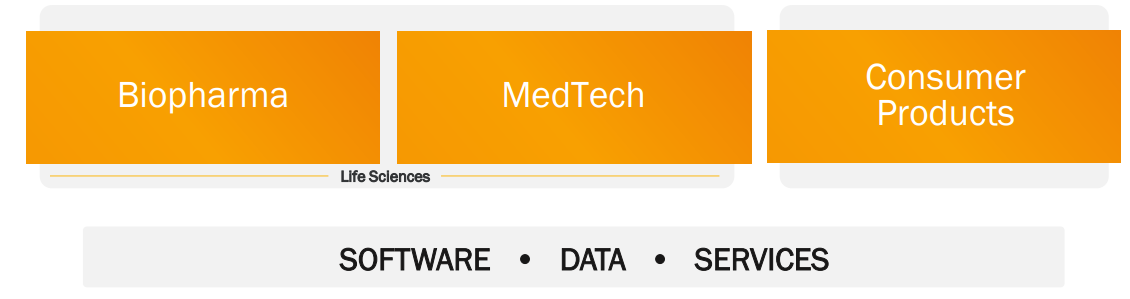
The bulk (>95%) of the revenue is generated from Life Sciences. Within Life Sciences, the majority of revenue is from Biopharma.
Products
Veeva’s vision is to Build the Industry Cloud for Life Sciences by bringing software and data together.
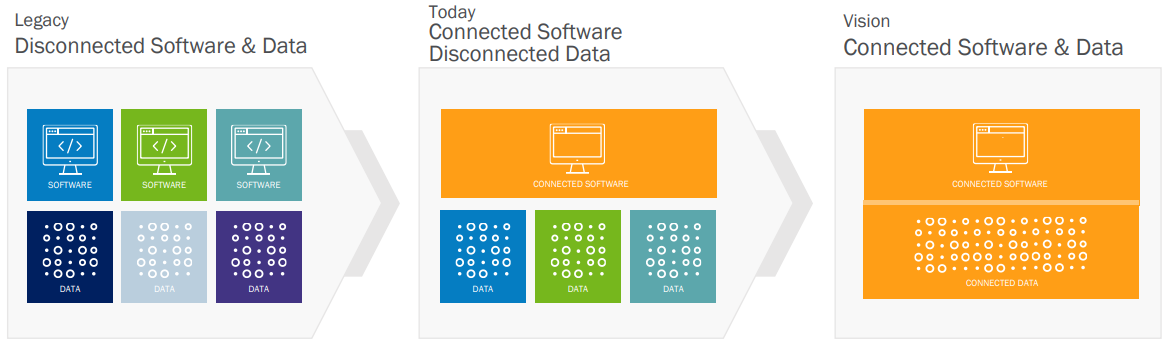
It plans to capitalize on its vison through its three product categories: Development Cloud, Commercial Cloud, and Data Cloud. These products are largely built on the vault platform.
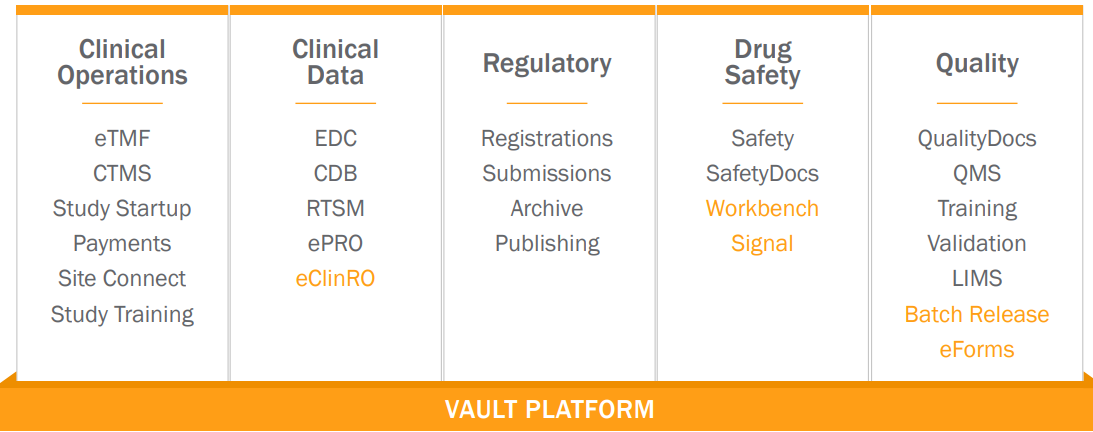
Development Cloud: helps life sciences companies develop drugs from idea to FDA trial. It includes applications for the management of clinical operations, regulatory, quality, and safety functions of life sciences companies. Veeva started building the Development Cloud more than 10 years ago and today it’s the standard technology for drug development.
Clinical Operations: provides tools that allows companies to start, document, monitor, and closeout trials in a regulated environment. It represents ~35% of the overall opportunity for Veeva.
Regulatory: provides the Vault RIM (Regulatory Information Management) product to streamline global regulatory processes on a single, cloud-based platform to improve visibility, data quality, and agility.
Quality: End-to-end tools for processes, updating content, and training.
Safety: Intake and reporting system for adverse event collection, management, and reporting.
Adverse events are events related to the drug, device, or other products (i.e. seizures, heart attacks, etc. depending on the drug).
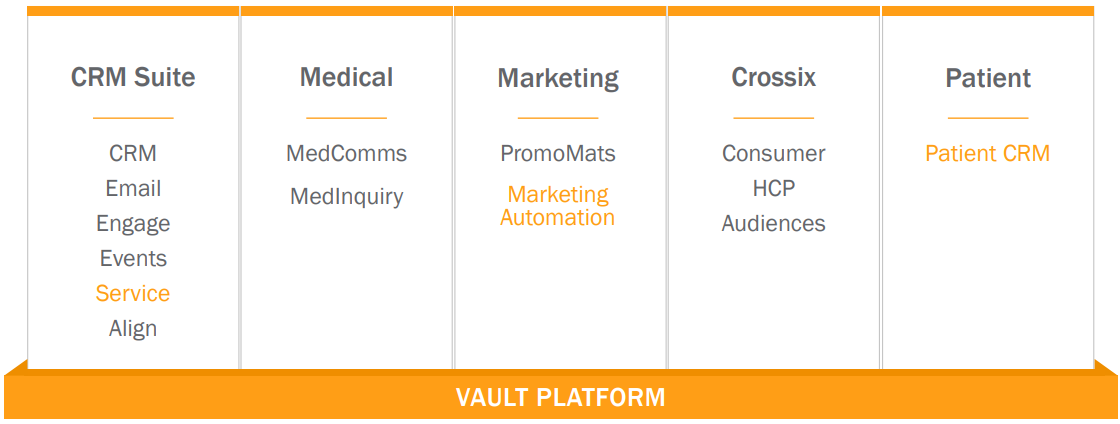
Commercial Cloud: provides a suite of tools to communicate to stakeholders after a drug goes public. Veeva CRM is the biggest product in this category. You can think of Veeva CRM like Salesforce CRM, but designed specifically for the life sciences industry.
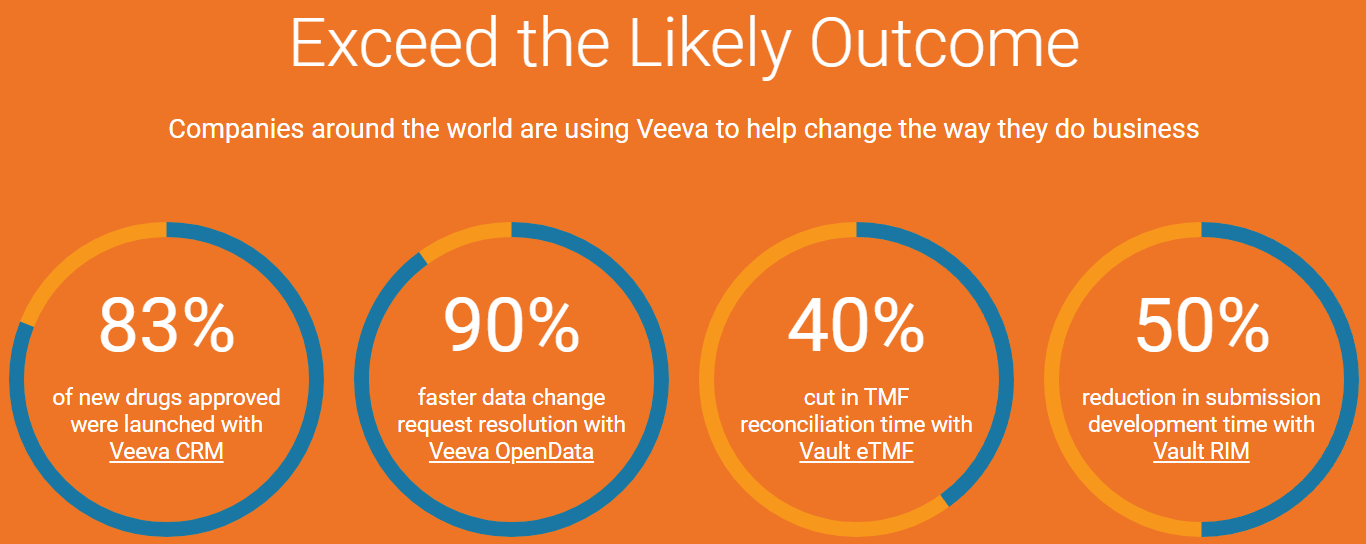
According to management, Veeva's industry-leading CRM platform powers the launch of a staggering 83% of newly approved drugs.
It’s important to note that Salesforce currently provides the cloud infrastructure for Veeva CRM through a 10 year agreement that lasts until 2025. However, Veeva does not plan to renew the agreement in 2025. It will instead migrate to its internal Vault platform. This will allow Veeva more freedom and flexibility but will also come with risks (more in the risks section).
The company also offers products specifically geared towards medical, marketing, and patients as part of Commercial Cloud.
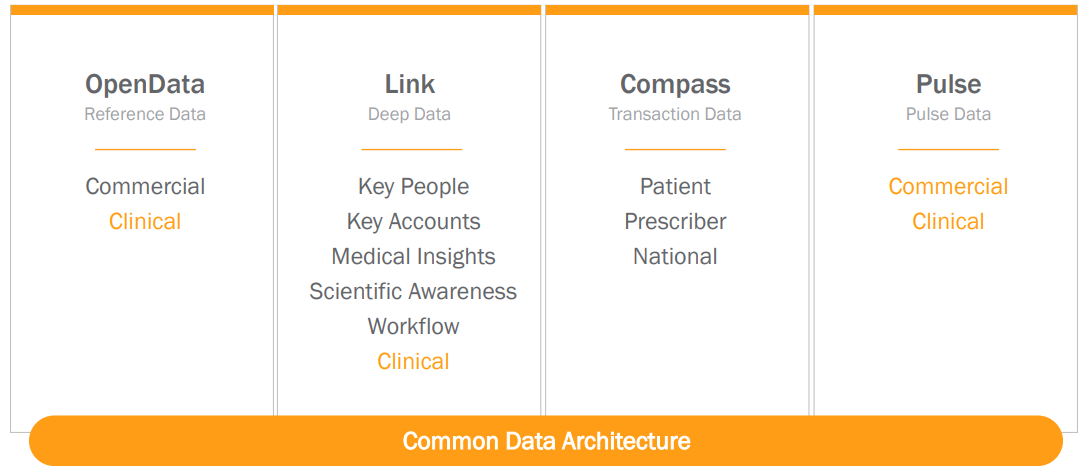
Data Cloud: the newest area for Veeva and another opportunity of potential growth. There’s 4 different types of data within Data Cloud:
a. Reference Data: contains reference data including demographics, license information and status, specialty information, and affiliations about doctors and hospitals and is used for customer compliance.
b. Deep Data: A mixture of data with a cloud application and cloud application that already has data in it. You can think of the Bloomberg terminal as an example of deep data. It allows for the generation of deep data with real-time intelligence for key people, publications, conferences, and digital engagement. Veeva plans to expand deep data to clinical operations as well.
c. Transactional Data: Specific to the U.S market and includes patient data for launch planning, patient segmentation and targeting, and analytics.
d. Pulse Data: Data generated by Viva applications to provide a view into what the industry is doing in aggregate. Just like Deep Data, Veeva plans to expand Pulse Data to clinical operations sometime in 2025.
The Opportunity
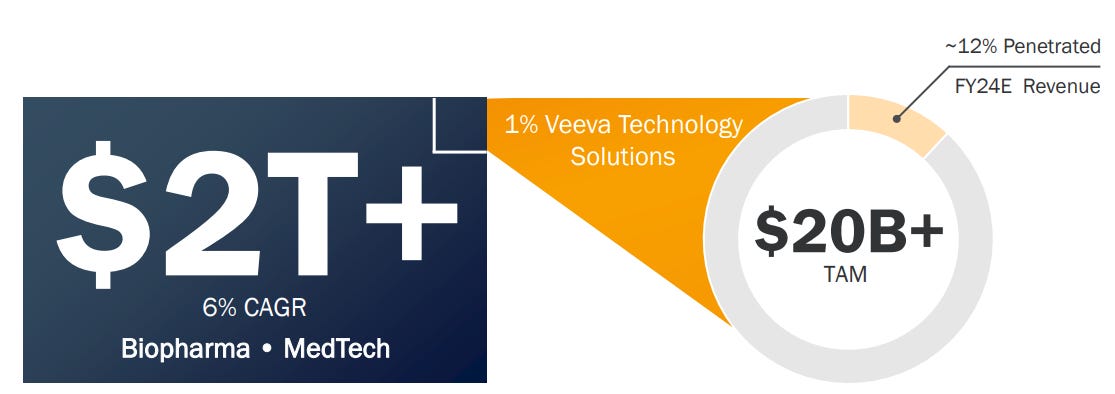
The Life Sciences industry is large ($2T+ in revenue) and growing at ~6% per year. Veeva estimates its Total Addressable Market (TAM) at $20B+ or 1% of the $2T TAM.
Spending 1% on industry-specific technology to get faster and more efficient is reasonable and Veeva estimates that percentage will only grow as the industry becomes more tech enabled. Currently, Veeva estimates its only penetrated 12% of its TAM, leaving plenty of room for growth.
Competition
Veeva operates in a competitive industry. It competes with multiple companies due to the variety of products it offers. Its main competitor within Commercial Cloud is IQVIA ($IQV), which also offers a CRM application built on the Salesforce Platform along with other products.
Veeva also competes to replace client server-based legacy solutions offered by companies like Oracle, Microsoft, and other smaller players. Some customers may use cloud-based solutions on platforms that are not life sciences specific, such as Salesforce (CRM), Amazon Web Services (AMZN), or Microsoft (MSFT) for particular functions.
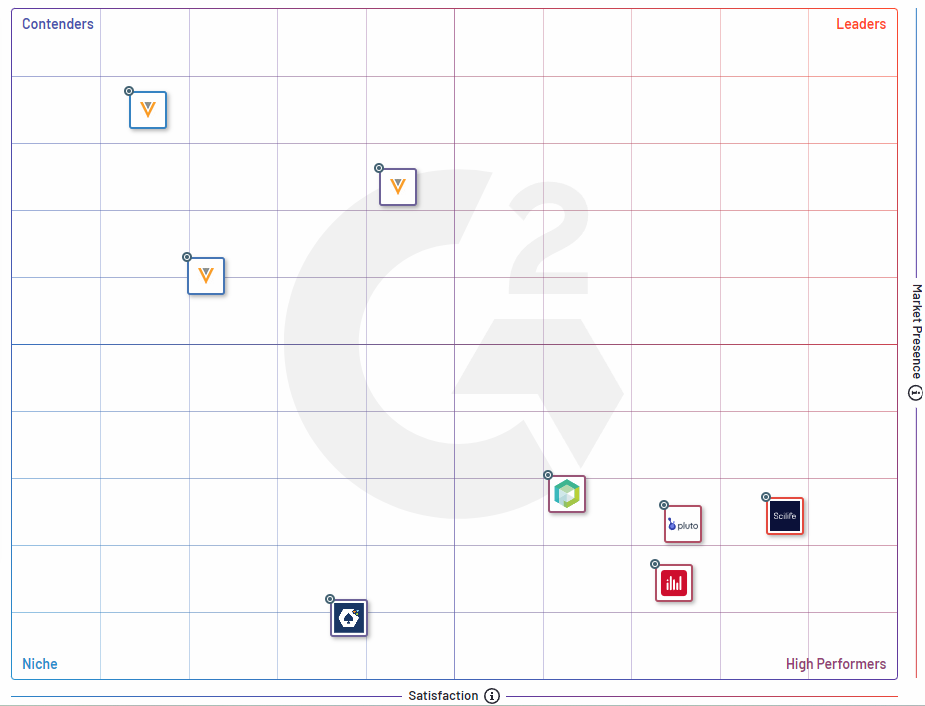
No single vendor offers products that compete with all of Veeva Vault applications. The below G2 grid showcases 3 of Veeva’s products with a dominant position compared to other software solutions in the pharma and biotech category.
Business Model
Veeva is a SaaS (Software-as-a-Service) company. It aims to acquire, retain, cross sell, and upsell customers. Therefore, one of the most important metrics to watch is net revenue retention rate.
Net revenue retention rate can show you how fast a company can grow without adding any new customers. It can be tough to grow your business by only acquiring new customers; hence cross selling and upselling your products to existing customers can help fuel growth.
Most SaaS companies provide a net revenue retention rate quarterly. Veeva typically provides its subscription net revenue retention rate annually. It was a healthy 120%, 124%, and 119% in FY 2020, 2021, and 2022. However, Veeva did not share its subscription net revenue retention rate in FY 2023 and didn’t provide any commentary around why. This is a yellow flag in my book. When management suddenly stops providing a key metric, one can’t help but question it.
Since Veeva relies on acquiring, retaining, cross selling and upselling its products to customers, it’s important to track the trend in the number of customers and the number of products customers use over time. Veeva shared its customer trends at its annual Investor Day conference.
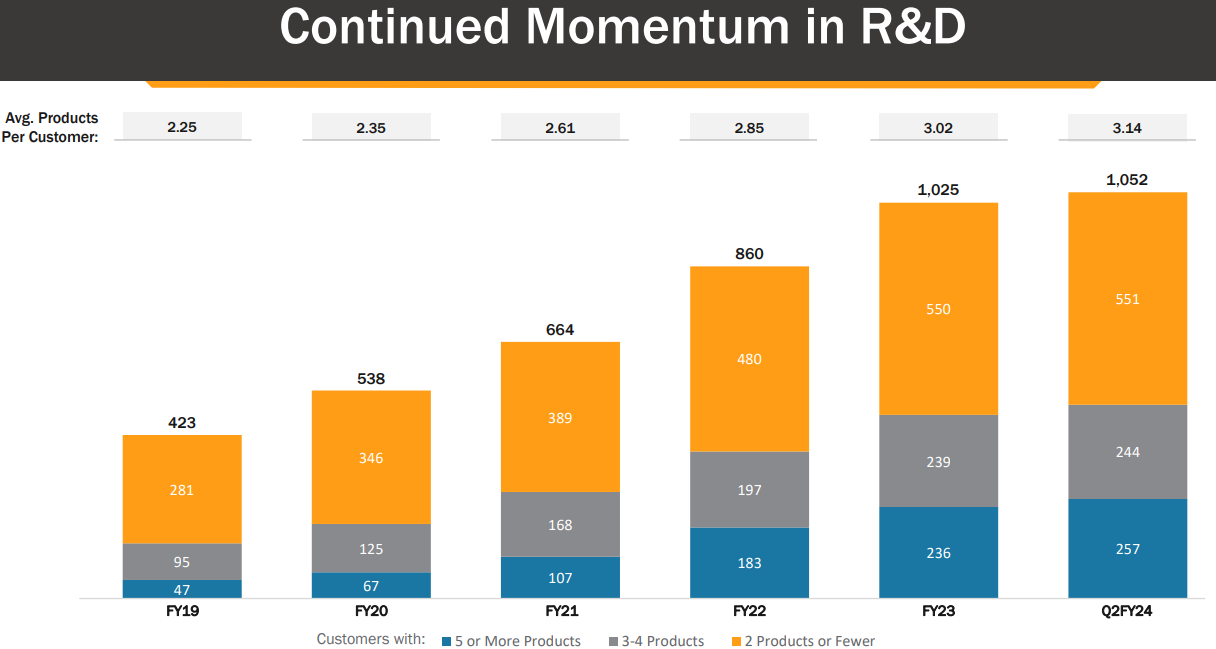
Development Cloud: the average number of products continues to increase steadily with 1,052 total customers as of Q2FY24. Specifically, customers using 5 or more products increased from 47 in FY19 to 236 in FY23.
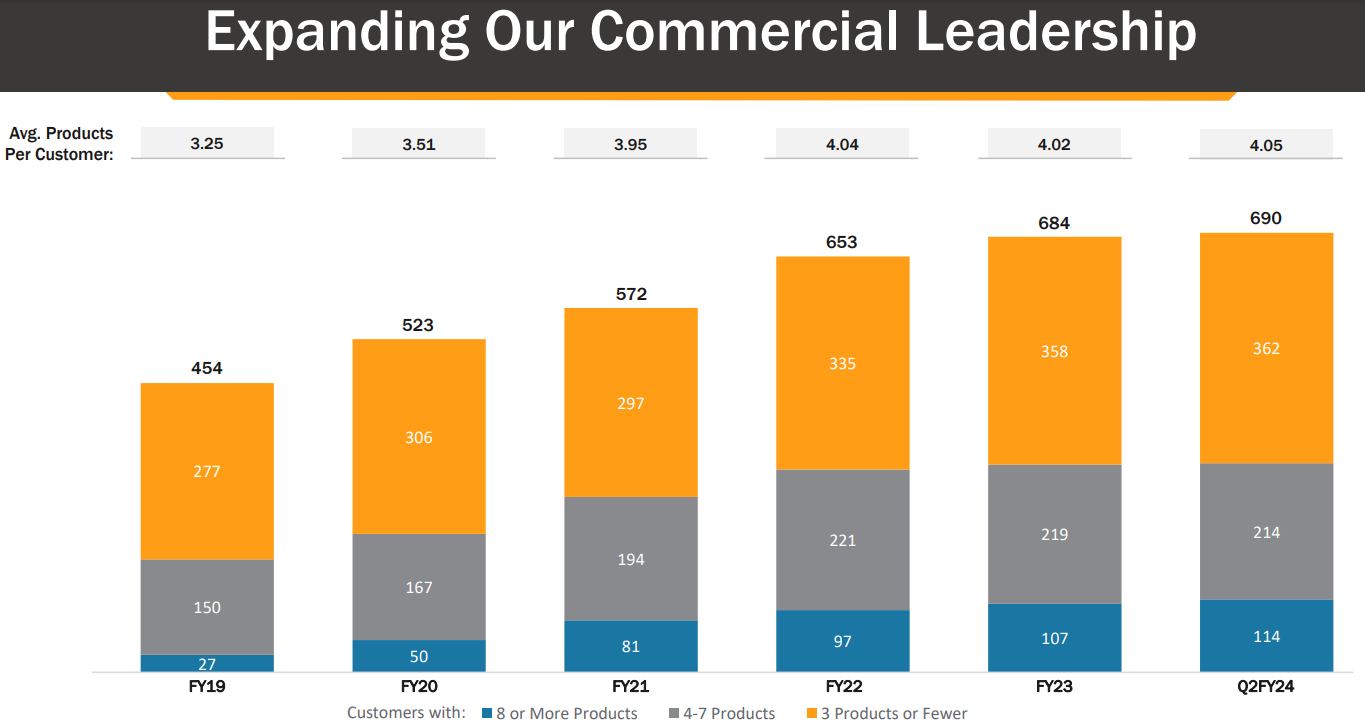
Commercial Cloud: Again, the average number of products continues to increase steadily with 690 total customers as of Q2FY24. Specifically, customers using 8 or more products increased from 27 in FY19 to 107 in FY23.
While a total of ~1,742 customers might not seem a lot, one has to consider the types of customers that Veeva serves:
Large Global Pharmaceutical and Biotechnology Companies: Bayer AG, Boehringer Ingelheim GmbH, Eli Lilly and Company, Gilead Sciences, Inc., Merck Sharp & Dohme Corp., and Novartis Pharma AG.
Emerging Growth Pharmaceutical and Biotechnology Companies: Alkermes Inc., Alnylam Pharmaceuticals, Inc., bluebird bio, Inc., Idorsia Pharmaceuticals Ltd, and Moderna Therapeutics Inc.
Veeva also provides solutions to companies in the Consumer Products & Chemicals industries. However, since the customers Veeva serves are mostly large enterprises, there’s significant room for Veeva to continue cross-selling and upselling its products over time.
Financials:
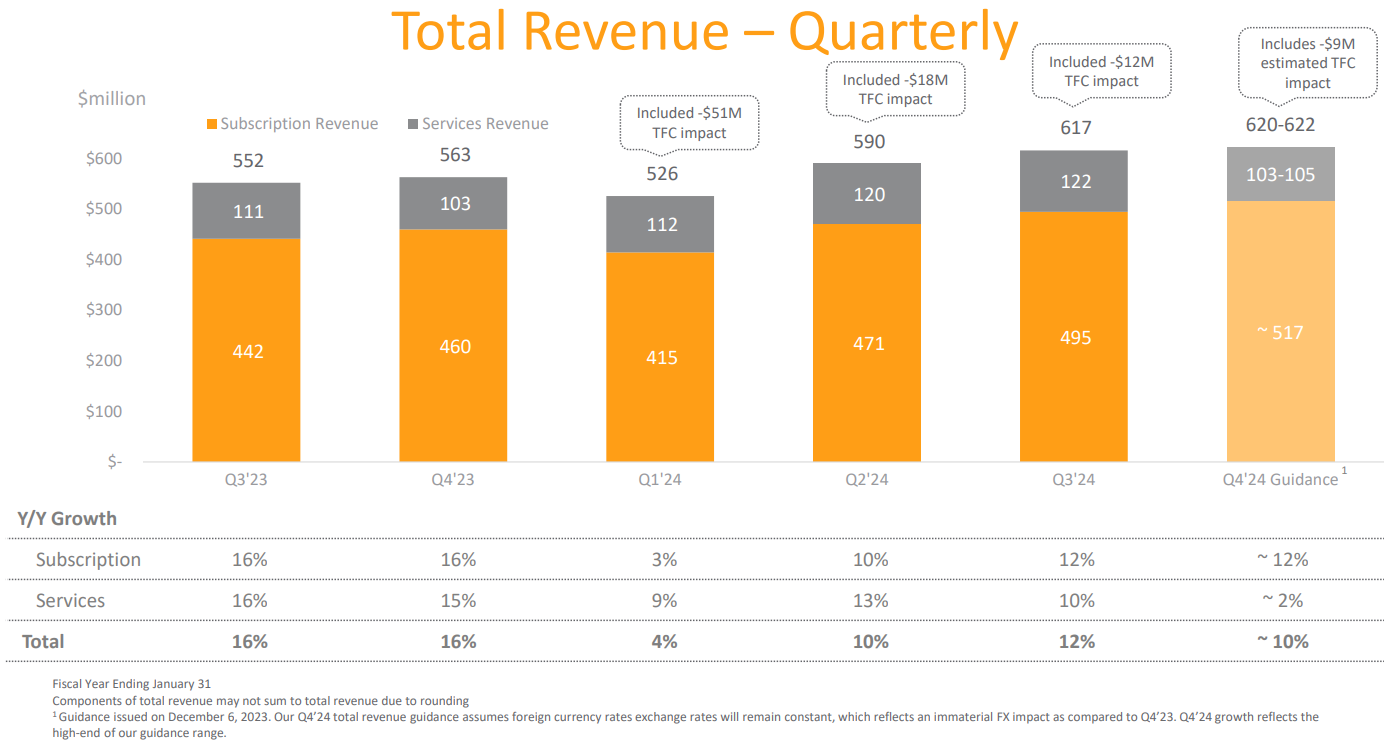
Let’s start with revenue. Veeva categories revenue into subscription revenue (~80%) and services revenue (~20%). In the most recent quarter, revenue was $617M, representing total growth of 12% Year over Year (YoY).
Veeva derives a significant portion of its revenues from its top 10 customers. In fiscal year 2023, 2022, and 2021, the top 10 customers accounted for 29%, 31%, and 36% of total revenues. Geographically, the trend is more encouraging. In 2023, 57% of subscription services revenue was from North America, 28% from Europe, and 15% from other locations, primarily Asia Pacific.
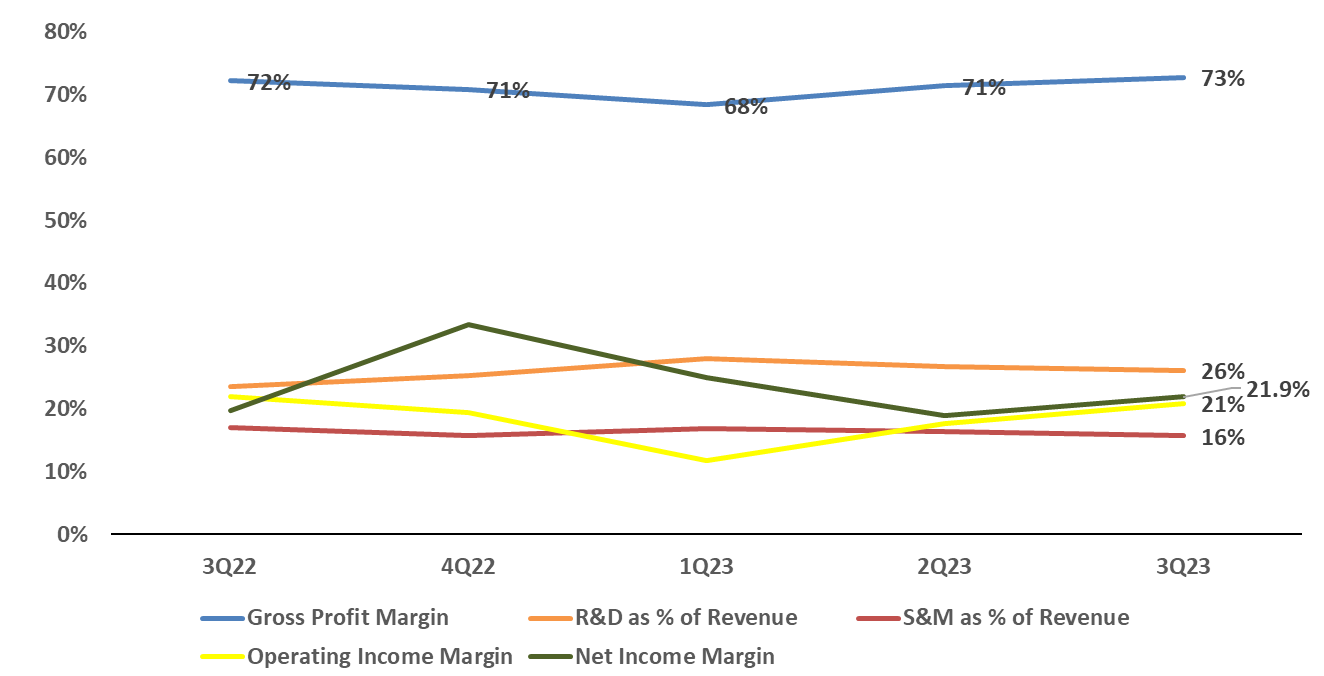
Veeva’s gross margin hovers around 70% as the subscription business gross margin is ~85% and service business margin varies high 20s and low 30s. Veeva is one of the few companies in the SaaS universe that spends more on Research & Development (R&D) than on Sales & Marketing (S&M). As of the most recent quarter, Veeva spent 26% of revenue on R&D while S&M has consistently hovered around 15%.
Source - Author using company filing data
Veeva’s operating income was $128.5M in 3Q23, an operating margin of 21%. Net income margin has been higher, helped by interest income. There is no doubt Veeva has consistently demonstrated profitable growth.
See below for the most recent guidance from the company. The FY guidance was lowered by $10M (-0.5%), largely due to expectations of lower services revenue due to a challenging environment where customers are looking to cut costs.
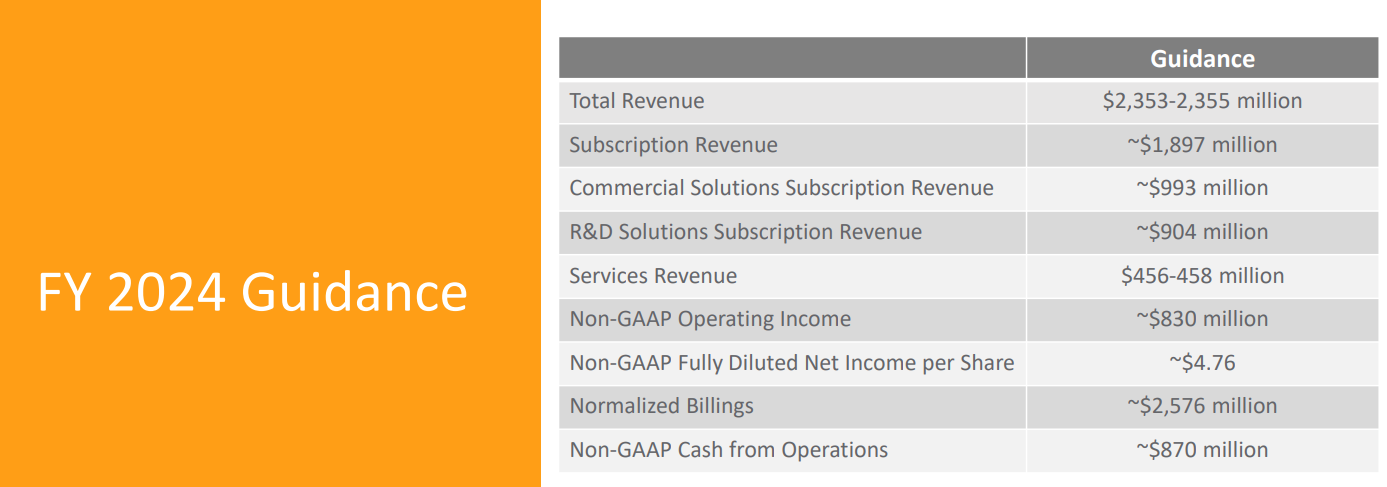
The thesis for Veeva doesn’t revolve around services revenue and management expects it to stabilize over time and stay consistent. Additionally, the FY25 guidance remains largely unchanged with at least $2.75B in revenue and at least $1B in non-GAAP operating income.
Risks
Veeva faces many risks but the three key risks are:
Life Sciences Industry: Since Veeva relies on the Life Sciences industry for a majority of its revenue, factors that affect the industry could easily impact Veeva. For example:
New or increased regulations could result in life sciences companies reducing the number of sales representatives that use Veeva’s products.
Industry consolidation could squeeze profits as customers reduce or remove subscriptions to streamline operations. Additionally, potential consolidation increases the risk of customer concentration.
Changes in the environment (i.e. funding of early stage life sciences companies) has and could negatively impact Veeva’s revenue.
Migration of CRM applications to Vault Platform: Salesforce currently provides the cloud infrastructure for Veeva CRM through a 10 year agreement that lasts until 2025.
There could easily be disruptions in the migration process.
Customers could leave Veeva for another company that offers CRM capabilities on the Salesforce platform (i.e. IQIVA).
Salesforce could launch its own Life Sciences CRM application after the agreement with Veeva ends.
The good news here is that two of the top 20 biopharma’s have already selected Vault CRM and plan to begin migrating in 2025.
AI Disruption
Since Veeva is a vertical SaaS company, the potential for low cost and low code AI solutions disruption needs to be monitored.
However, it won’t be easy as Veeva’s solutions are tailored to the Life Sciences industry with deep domain expertise. There is no doubt in my mind that Veeva is well aware of this risk and is investing in AI to try to stay ahead of the curve.
Conclusion
Veeva Systems is a leading player in the life sciences software space, boasting a strong position in both Development and Commercial Cloud segments. It benefits from a consistently growing industry, high customer retention, and significant room for cross-selling and upselling its products. However, management’s decision to not share subscription revenue retention rate for 2023, dependence on large pharmaceutical companies, and the upcoming migration of its CRM platform pose risks.
Personally, we’ll be keeping our eyes on a few items:
Re-acceleration of revenue growth as development cloud becomes a larger pie of revenue
Transition of Commercial CRM to Vault CRM and its impact on the company
Potential AI disruption and how Veeva plans to stay ahead of the curve
Whether Veeva can maintain its combination of healthy revenue growth and strong profitability
If you enjoyed this article, please consider sharing and subscribing. Thank you!